Meet Peter Palmer.
Working screen actor for over two decades. Quiet specialist in the on-set craft drama school never taught.
He’s the person other actors call before their first big set. Now he’s put 20 years of marks, eyelines, prop blocking and crew language into one masterclass — so the next generation walks on ready.
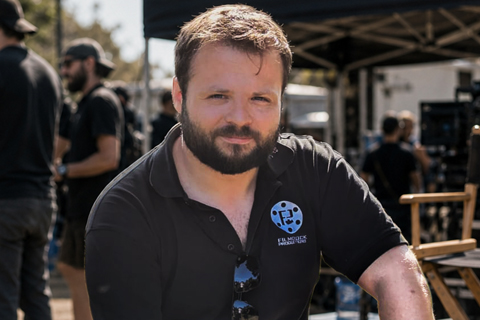
From drama school graduate to set veteran.
Peter trained classically. Three years of voice work, scene study, Stanislavski, Meisner — the full conservatoire programme. He left with a portfolio of monologues, a body that could move a room, and absolutely no idea what a “first team” was.
Then came his first real set. Twenty extras, a crane shot, and a 1st AD calmly asking him to “find your mark, hold for focus, and play it down for the close.” He’d never been told what any of those things meant.
That afternoon he kept his job by watching — and asking the most senior actor on set every question, between takes, for three days straight. He didn’t get fired. But he never forgot how unprepared he was for the room he’d spent years training to enter.
He’s been on screen ever since: features, long-running TV, prestige limited series, commercials shot in twelve countries. The kind of CV that comes from being the actor who makes the day, not the one who slows it down.
Acting is the easy part. The set is the hard part.
Craft is honoured. Process is taught.
Drama school gives you instinct, range, and emotional access. This masterclass adds the working language of a film set on top of it — never instead of it.
Every take is a problem to solve.
A close-up on a 50mm lens is a different acting problem from a master on a wide. Peter teaches the technical thinking that makes performances reproducible, take after take, hour after hour.
The crew is your scene partner.
Sound, focus puller, gaffer, AD — every department is shaping your performance. Knowing how to work with them, not around them, is what separates good actors from booked actors.
There’s a missing year in actor training.
“The first set I worked on, I cost the production a take because I didn’t know to wait for ‘speed.’ Nobody got angry. They were just used to it. That’s the part that still bothers me. Twenty years on, drama schools still aren’t teaching this — and I see it on every set, in every new face, every year. So I made the thing I wish someone had handed me at twenty-two.”